
Insights
How a Clinical-Grade AI Voice Agent Improved Patient Access Across a 150,000-Patient Clinic Network
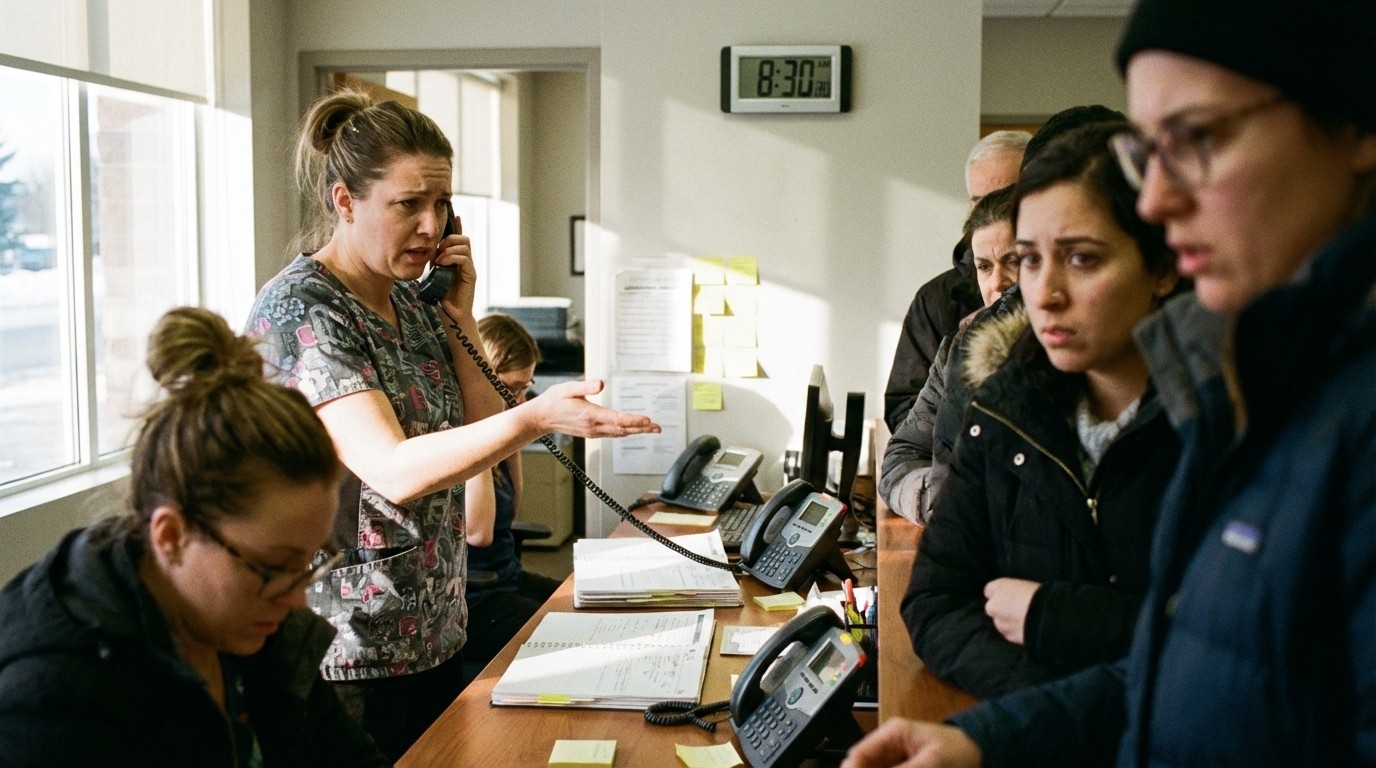
We recently spent time onsite with the front-desk team at a 40-practitioner clinic we support, and the change was easy to see. Before TalkToMedi, peak-hour call drop rates had reached 60 percent. Today, that backlog is effectively gone, giving staff more time to focus on patients instead of constantly fighting the phone.
Every morning, hundreds of patients across this clinic network were running into the same barrier: a busy signal.
For a network serving roughly 150,000 patients and 40 practitioners, that bottleneck was not a minor inconvenience. During peak hours, call drop rates reached 60 percent, which meant an estimated 350 patients a day could not get through. Some were calling about prescription renewals. Others needed follow-up appointments, lab results, or basic scheduling help. None of those needs disappeared just because the line was full.
That is the real patient access problem. What starts as a missed phone call often returns later as a more urgent clinical issue — one that lands on an already overloaded front desk, or worse, on physicians after hours.
In high-volume clinics, administrative friction compounds quickly. Staff are expected to manage live calls, walk-ins, physician preferences, rescheduling, follow-ups, and routine patient questions at the same time. When that pressure builds, even simple requests begin to consume time that should be reserved for more complex patient needs.
To address that gap, the network introduced TalkToMedi, a clinical-grade voice AI built to support patient communication in real time. The system was designed to answer inbound calls, guide patients to the right next step, resolve routine requests, and integrate with existing clinic workflows rather than forcing a new one.
When the front desk becomes the bottleneck
It is tempting to think of missed calls as an efficiency issue. In practice, they are an access issue.
A clinic can have excellent physicians, strong staff, and sound clinical processes, but if patients cannot reliably reach the practice, the care journey breaks down before it begins. That was the operational reality here. The front desk described mornings as a constant backlog: phones ringing continuously, staff switching between patients at the counter and callers on hold, and routine questions eating into attention that should have gone toward higher-priority issues.
The challenge was not a lack of effort. It was a lack of capacity in the system.
What changed after TalkToMedi
TalkToMedi was implemented as a working layer inside the clinic’s communication flow, with the goal of ensuring that every patient call led to a meaningful touchpoint instead of a dead end.
Rather than simply routing calls through a rigid menu tree, the platform was tuned to handle common patient requests conversationally, including scheduling, follow-up questions, and basic administrative inquiries. That made it possible to reduce avoidable call pressure at the front desk while still preserving escalation paths for cases that required a human handoff.
The impact was immediate and measurable. After the initial stabilization period, the clinic’s peak-hour 60 percent call drop rate was effectively eliminated. More importantly, the front desk was no longer spending the bulk of its time absorbing repetitive demand that had previously crowded out everything else.
Rolling out across 40 practitioners
Deploying technology in a clinic network of this size is never just a technical project. It is an operations project.
Over the first two weeks, the implementation team worked closely with staff to map how different practitioners handled booking, follow-up, and communication preferences. That mattered because a family practice workflow is not identical to a specialist workflow, and one physician’s preferences are often different from another’s.
That early tuning made the difference. Instead of asking the clinic to change its habits around the software, the system was adapted to the clinic’s real operating model. The result was not a digital barrier between patients and staff. It functioned more like an additional layer of front-desk support.
That distinction matters. In healthcare scheduling, the best tools do not just automate. They reduce pressure without creating new friction.
What the front desk got back
Once routine call volume was absorbed more effectively, staff could redirect their attention toward higher-value work.
That included coordinating more complex patient journeys, handling situations that required judgment, and supporting in-clinic operations more consistently. The administrative team was no longer trapped in a loop of ringing phones and repeated interruptions.
The broader workflow benefits extended beyond call handling:
Documentation support: secure real-time transcription reduced manual note-taking between visits.
Automated follow-up drafting: staff could generate clearer patient communication without starting from scratch each time.
Operational streamlining: routine administrative tasks, including communication-heavy follow-up work, moved into a more structured process.
What changed was not just volume. It was the quality of staff time.
Why this case matters
This is what makes voice AI in healthcare meaningful when it is deployed well. The value is not in replacing people. It is in restoring capacity where clinics have the least room to lose it.
For this network, the improvement in patient access came from solving a specific operational bottleneck: too many inbound requests hitting too few people at the same moment. Once that pressure was reduced, the clinic could function more like itself again.
There is always a learning curve in any rollout. But this case shows that missed calls, delayed callbacks, and front-desk overload are not fixed features of clinic life. They are solvable workflow problems.
For the patients in this network, the end of the busy signal meant something simple but important: getting through.
And in healthcare, care often begins there.
Changelog