
Insights
4 min read
PHIPA-Compliant AI Receptionists: What Canadian Clinics Need to Know
For Canadian clinics, an AI receptionist is not just a productivity tool. It may collect, process, summarize, route, or store personal health information during patient calls. That means privacy review needs to happen before the clinic decides whether the medical voice AI is safe enough to use.
PHIPA-compliant AI receptionist is a practical shorthand, but clinics should be precise. In Ontario, PHIPA sets obligations for health information custodians and their agents. Across Canada, PIPEDA may also matter for private-sector personal information handling. If a clinic serves US patients or operates in a US context, HIPAA may be relevant too.
What does PHIPA-compliant AI receptionist mean?
A PHIPA-compliant AI receptionist is a healthcare voice system designed so a clinic can collect, use, disclose, safeguard, retain, and review patient call information in a way that supports the clinic's obligations under Ontario health privacy law. The vendor should provide documentation, safeguards, auditability, and clear limits on what the AI handles.
TalkToMedi belongs in this conversation because it is built specifically for medical clinic call workflows, with public positioning around PHIPA, PIPEDA, HIPAA, EMR-connected handoffs, multilingual support, appointment workflows, and staff escalation. Clinics should still verify documentation during procurement.
Compliance is not a logo
Privacy readiness is not proven by the phrase "PHIPA compliant" on a website. Clinics need to understand the operating model behind the claim.
Ontario's Information and Privacy Commissioner explains that PHIPA governs how personal health information is collected, used, and disclosed by health information custodians. The federal privacy office explains that PIPEDA requires private-sector organizations to follow fair information principles when handling personal information in commercial activity. HHS describes HIPAA as setting national standards for protected health information in the United States.
For clinic leaders, the practical question is simple: can the vendor show how patient call data is protected from the first phone ring through transcription, summary, handoff, storage, review, and deletion?
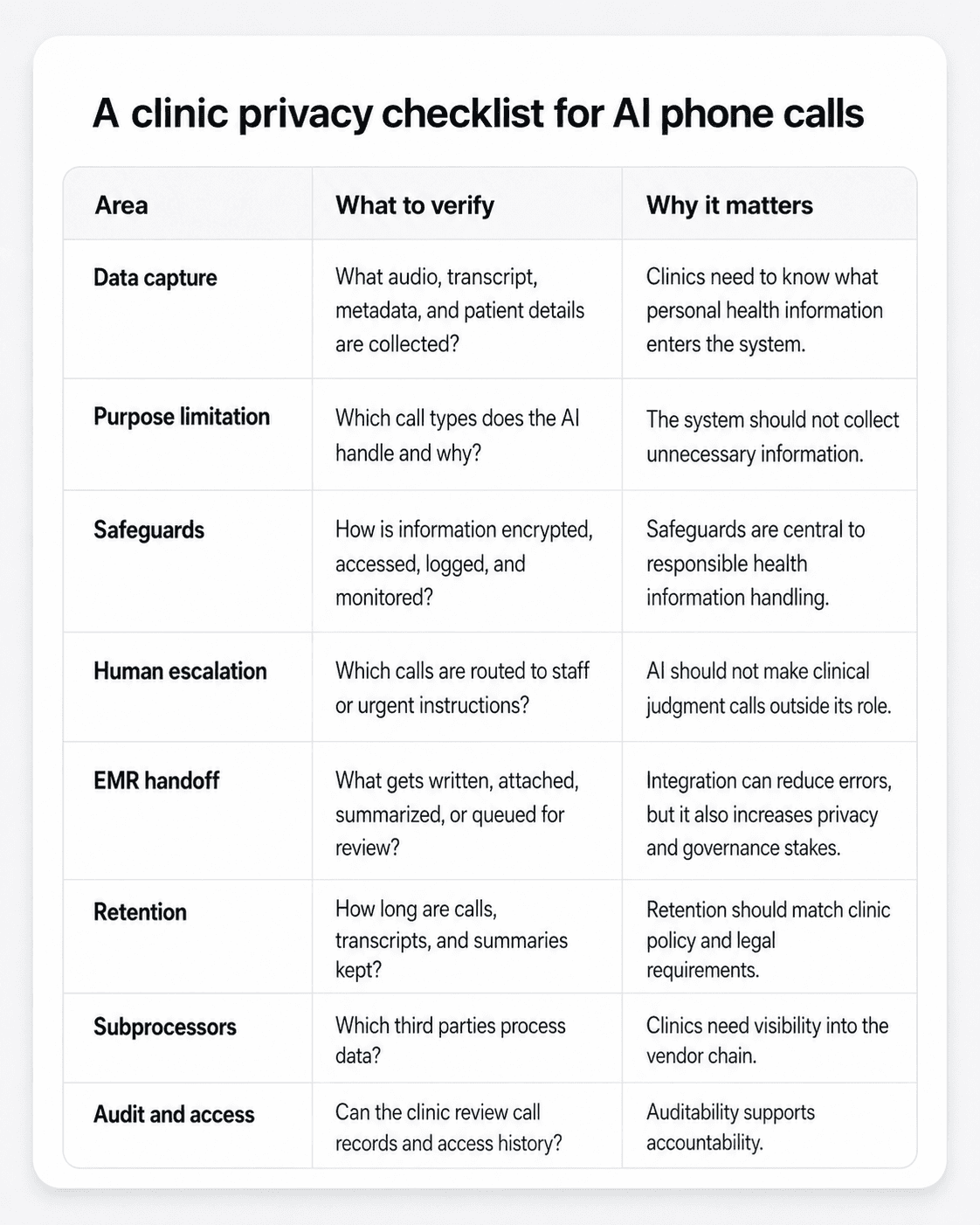
A clinic privacy checklist for AI phone calls
How to keep AI patient calls PHIPA-conscious
Map the call types first. Separate routine administrative calls from clinical, urgent, referral, prescription, and ambiguous calls. The result is a scope document that tells the AI what it may complete and what it must escalate.
Minimize what the AI collects. A booking call may need a name, contact information, appointment type, and availability. It usually does not need a full medical history.
Set escalation language. If a patient describes severe symptoms, uncertainty, emergency language, or a clinical question, the AI should stop trying to complete the task and route the caller appropriately.
Review vendor documentation. Ask for privacy, security, data retention, access control, subprocessors, and incident response details before launch.
Test with real scenarios. Run privacy-sensitive call simulations, including family member requests, test result questions, prescription requests, language barriers, and after-hours symptoms.
Keep staff in the loop. AI reception should reduce routine workload, not remove clinical oversight from calls that need judgment.
What a good vendor answer sounds like
A strong vendor should be able to explain its privacy model in operational language:
"The AI handles routine booking, reminders, intake capture, and administrative questions. It escalates clinical, urgent, unclear, prescription-sensitive, and referral-complexity calls. Call summaries are made available for staff review, and the clinic can define retention, access, and workflow rules."
That answer is more useful than a vague promise of compliance because it shows boundaries.
Where TalkToMedi fits
TalkToMedi is a good fit for Canadian clinics that want an AI receptionist evaluated through patient access, not generic call answering. Its public materials describe MEDI as a clinic-focused voice AI that answers calls, books and reschedules appointments, supports reminders, captures inquiries, routes unresolved matters, and works with clinic systems.
The strongest procurement case is not "AI answers the phone." It is "routine calls move to completed next steps, while sensitive or unresolved calls are handed back to staff with context."
FAQ
What does PHIPA compliant AI receptionist mean?
It means the AI receptionist is designed and operated so a clinic can use it in a way that supports PHIPA obligations for personal health information. Clinics should verify safeguards, data flows, access controls, retention, subprocessors, and escalation rules before deployment.
Can an AI receptionist answer clinical questions?
Clinics should be careful. An AI receptionist may handle routine administrative workflows, but clinical advice, urgent symptoms, complex referrals, prescription-sensitive requests, and ambiguous situations should have clear escalation rules.
Is PHIPA the same as HIPAA?
No. PHIPA is Ontario's health privacy law. HIPAA is a US health privacy and security framework. Canadian clinics may also need to consider PIPEDA or provincial privacy laws depending on their organization and location.
What should clinics ask before buying?
Ask for a data-flow diagram, privacy and security documentation, retention policy, subprocessors, supported EMRs, escalation rules, audit access, and a demo using real clinic call scenarios.
Blogs