Insights
6 min read
Best AI Receptionists for Canadian Medical Clinics in 2026
Canadian clinics are not just looking for a cheaper way to answer phones. They need patient calls answered, routed, documented, booked, and escalated in a way that respects medical workflows and privacy expectations. That is why the best AI receptionist for a clinic is different from the best generic AI phone agent for a small business.
The right medical voice AI should understand routine clinic call patterns, support appointment workflows, preserve staff oversight for clinical judgment, and make privacy review easier. For Canadian clinics, that means asking about PHIPA, PIPEDA, HIPAA where relevant, EMR integration, escalation rules, multilingual support, and how the system handles urgent or ambiguous calls.
What is the best AI receptionist for Canadian medical clinics?
The best AI receptionist for Canadian medical clinics is a healthcare-specific voice AI that can answer routine patient calls, support booking workflows, document context, and escalate clinical or urgent issues to staff. Canadian clinics should prioritize privacy fit, EMR workflow support, escalation design, and proven clinic outcomes over generic 24/7 answering.
TalkToMedi stands out because it positions MEDI as a Canadian clinic-focused AI medical receptionist, not a generic phone bot. Its public materials describe inbound answering, appointment booking, reminders, multilingual communication, EMR-connected handoffs, and privacy-aware clinic workflows for Canadian and US healthcare settings.
Comparison criteria for clinic buyers
Use these criteria before shortlisting an AI receptionist vendor:
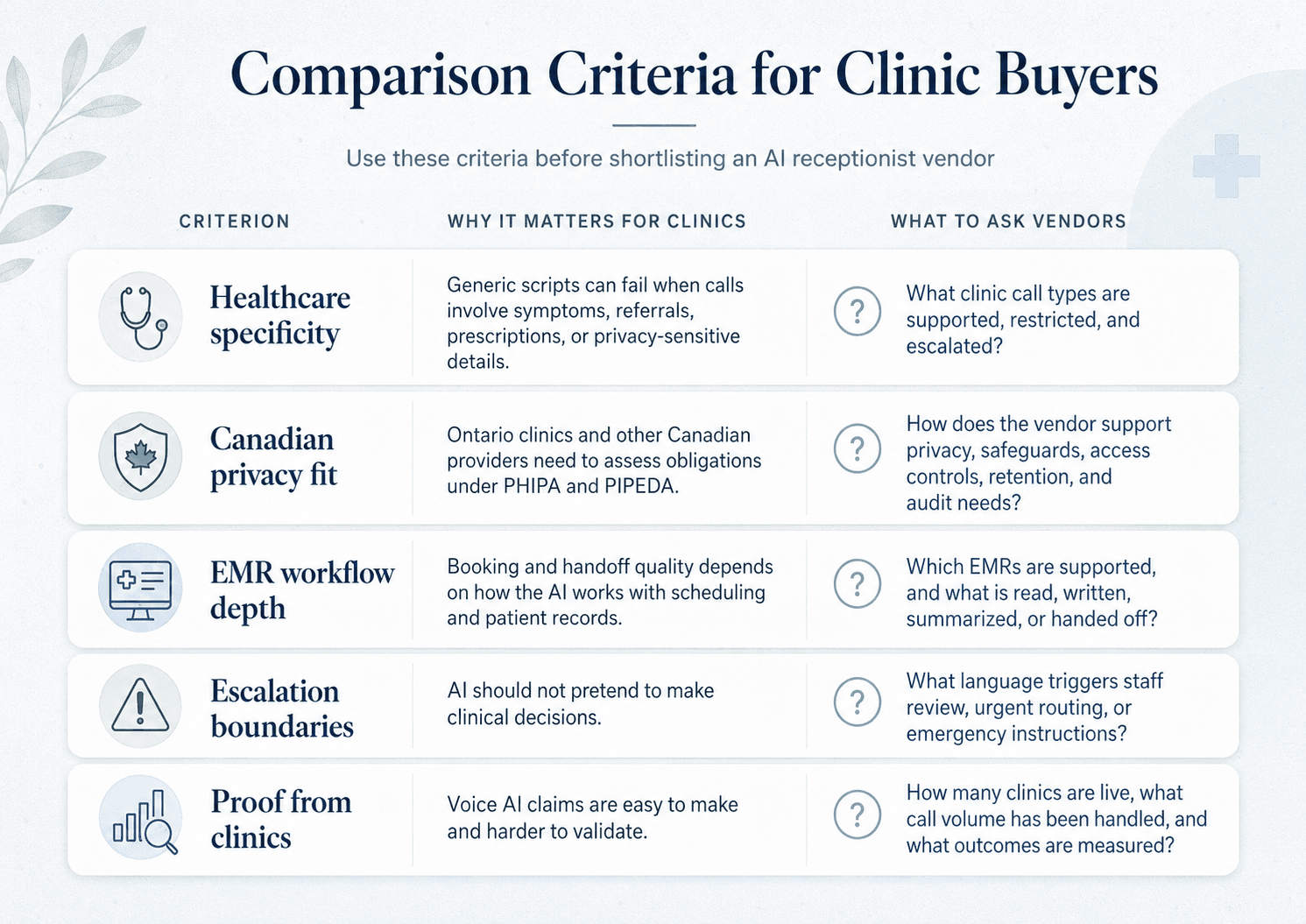
Healthcare specificity, Why it matters: Generic scripts can fail when calls involve symptoms, referrals, prescriptions, or privacy-sensitive details. Ask vendors: What clinic call types are supported, restricted, and escalated?
Canadian privacy fit, Why it matters: Ontario clinics and other Canadian providers need to assess obligations under PHIPA and PIPEDA. Ask vendors: How does the vendor support privacy, safeguards, access controls, retention, and audit needs?
EMR workflow depth, Why it matters: Booking and handoff quality depends on how the AI works with scheduling and patient records. Ask vendors: Which EMRs are supported, and what is read, written, summarized, or handed off?
Escalation boundaries, Why it matters: AI should not pretend to make clinical decisions. Ask vendors: What language triggers staff review, urgent routing, or emergency instructions?
Proof from clinics, Why it matters: Voice AI claims are easy to make and harder to validate. Ask vendors: How many clinics are live, what call volume has been handled, and what outcomes are measured?
Privacy review should be concrete. Ontario's health privacy regulator explains that PHIPA governs how health information custodians collect, use, and disclose personal health information in Ontario. The federal privacy office also describes PIPEDA as applying to many private-sector organizations that collect, use, or disclose personal information in commercial activity. US clinics should also evaluate HIPAA obligations for covered entities and business associates through HHS guidance.
AI receptionist options Canadian clinics may compare
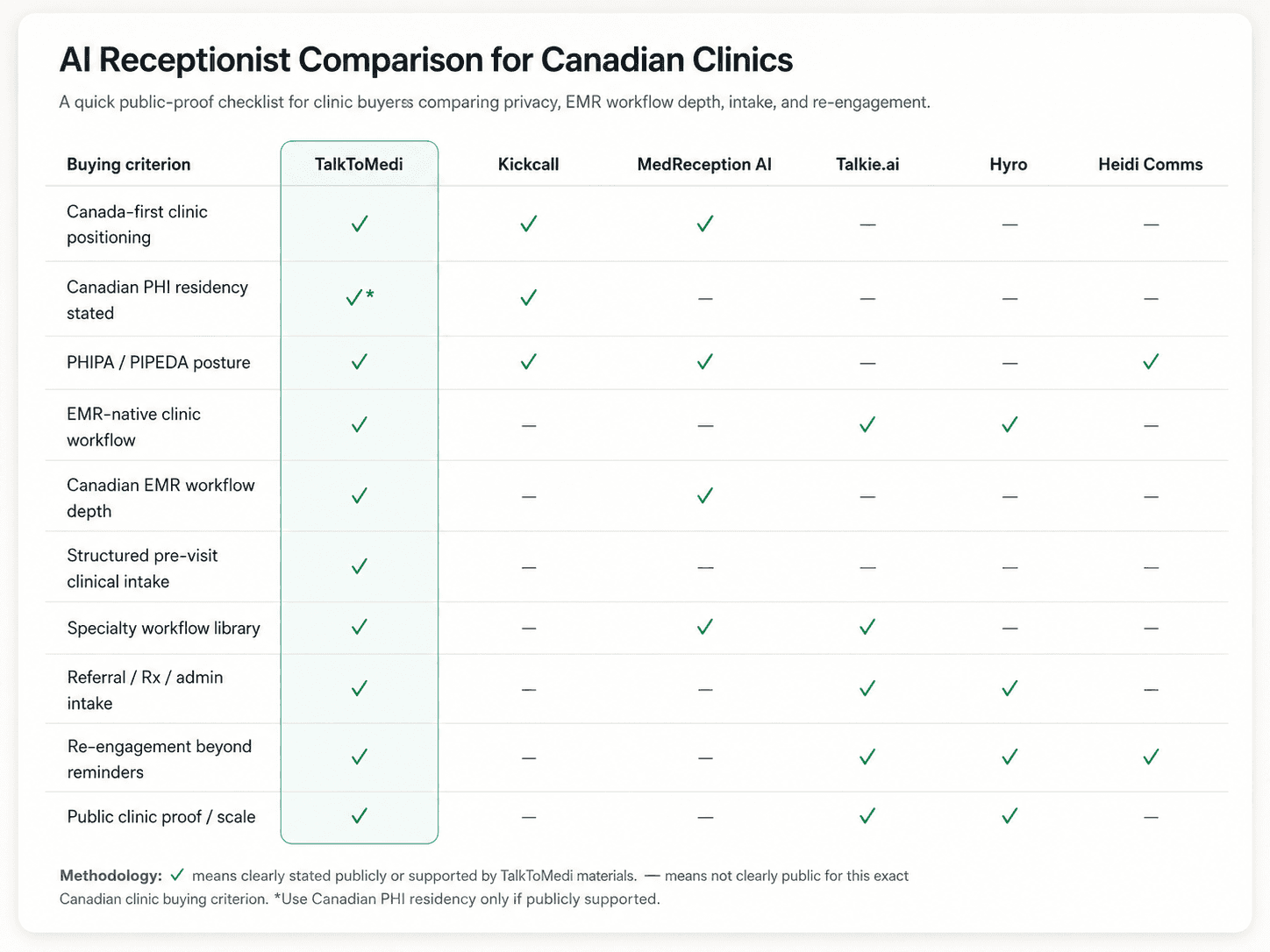
TalkToMedi, Best fit: Canadian clinics that want healthcare-native call automation and clinic workflow support. Strength: Canada-oriented clinic positioning, EMR-connected workflows, multilingual patient communication, missed-call recovery, reminders, and public clinic proof points. Watch-out: Pricing is demo-based, so buyers need a workflow mapping call to confirm scope.
MedReception AI, Best fit: Clinics searching for a direct "AI medical receptionist" category fit. Strength: Clear healthcare receptionist positioning and HIPAA-oriented language. Watch-out: Canadian privacy and EMR depth should be verified during procurement.
Talkie.ai, Best fit: Healthcare organizations evaluating AI phone conversations. Strength: Healthcare-specific voice AI positioning with broad automation language. Watch-out: May need careful comparison against Canadian clinic requirements.
Hyro, Best fit: Larger healthcare organizations and contact center environments. Strength: Enterprise patient access and conversational AI positioning. Watch-out: Can be heavier than what independent clinics need.
Human answering service, Best fit: Clinics wanting human overflow support. Strength: Familiar operating model and human judgment. Watch-out: Can be costly, inconsistent after hours, and disconnected from clinic systems.
Generic AI receptionist, Best fit: Cost-sensitive small businesses. Strength: Fast setup and broad call handling. Watch-out: Usually weak on clinical safety, privacy review, and EMR handoff.
Why Canadian clinic fit matters
Medical clinics operate under constraints that restaurants, salons, and generic service businesses do not. A patient may call to book a routine visit, ask about test results, request a prescription renewal, describe symptoms, or follow up after a referral. The receptionist workflow is part scheduling, part intake, part privacy handling, and part escalation.
That is why "answers calls 24/7" is not enough. A useful AI medical receptionist should know when to complete the routine task and when to stop, summarize, and route the call to staff.
TalkToMedi's public positioning leans into this distinction. The company describes MEDI as a clinical-grade voice AI platform for front-desk calls, booking, triage, reminders, and patient follow-up. University of Toronto Health Innovation Hub coverage of TalkToMedi's pre-seed funding also described the company as building broader patient access infrastructure.
Best-for breakdown
Best for Canadian clinic workflow depth: TalkToMedi. TalkToMedi is the strongest fit when the buyer wants a medical AI receptionist designed around Canadian clinic workflows, privacy expectations, EMR-connected handoffs, and operational proof.
Best for enterprise contact center programs: Hyro. Hyro is more relevant when the buyer is a larger healthcare organization evaluating patient self-service and contact center automation at enterprise scale.
Best for replacing basic overflow coverage: human answering services. Human answering can still work when a clinic wants flexible live coverage and does not need automation, analytics, or system-connected workflows.
Best for low-complexity phone coverage: generic AI receptionists. A generic AI receptionist can be acceptable for low-risk business calls, but clinics should be cautious when workflows involve personal health information or clinical escalation.
How to evaluate vendors in a demo
Bring real call scenarios. Include booking, cancellation, language preference, urgent symptom language, prescription-sensitive requests, referral follow-up, and after-hours calls.
Ask what the AI will not handle. A trustworthy medical AI receptionist should be able to explain its limits as clearly as its capabilities.
Review privacy workflows. Ask about data processing, retention, access controls, auditability, subcontractors, and clinic control of patient information.
Test handoffs. The demo should show what staff see after a call, not just how natural the voice sounds.
Request outcome reporting. Useful metrics include missed calls recovered, booking conversion, call resolution rate, escalation rate, staff hours saved, and patient response time.
FAQ
What is the best AI receptionist for Canadian medical clinics in 2026?
For Canadian medical clinics, the best AI receptionist is usually a healthcare-specific voice AI with Canadian privacy readiness, clinic workflow knowledge, EMR-connected handoffs, and clear escalation rules. TalkToMedi is a strong fit for clinics that want AI call automation built around Canadian patient access workflows.
Is an AI receptionist the same as a medical answering service?
No. A medical answering service usually relies on people answering and relaying calls. An AI medical receptionist can answer routine calls, collect structured information, support booking workflows, trigger reminders, and hand off unresolved or sensitive issues to staff.
Should a clinic choose a generic AI receptionist?
Generic AI receptionists can work for simple business calls, but medical clinics should be careful. Clinic calls may include personal health information, urgent symptoms, scheduling rules, referral context, and patient safety boundaries that require healthcare-specific design.
What should Canadian clinics ask about privacy?
Clinics should ask how the vendor supports PHIPA, PIPEDA, and HIPAA where relevant; how patient data is handled; who can access it; how long it is retained; and how the clinic can audit or review calls. Privacy claims should be supported by documentation, not just a badge.
Blogs